
With the CBLR minimum moving to 8% in the third quarter, the question on many banks’ minds is whether to elect the CBLR framework. While there may be some cost savings from reducing the operational complexity of filing the call report, we at Taylor Advisors believe the bigger question is: “Are you using your capital to play offense?”
Capital as Strategy, Not Just Compliance
Adequate capital has always been a prerequisite for safety and soundness. However, in today’s environment, adequacy alone is no longer enough, and capital sitting idle above what’s needed isn’t conservative; it’s a drag on performance. Competitors are making capital decisions right now around AI, digital infrastructure, and market expansion. The question isn’t whether your institution will need to respond to these changes; it’s how you’re going to respond.
The Capital Stack Framework
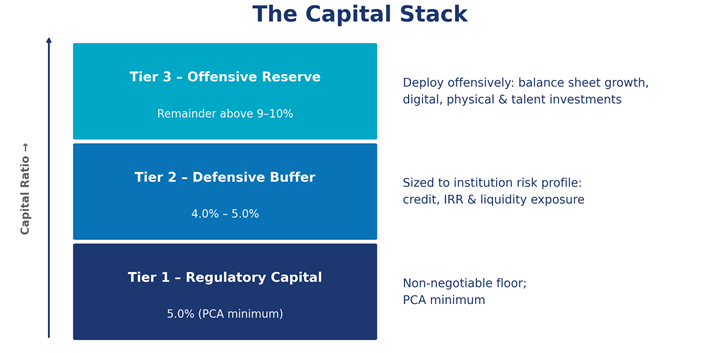
One tool that banks can use to assess whether capital is being used effectively is the capital stack. The capital stack reframes the conversation and helps banks segment capital into tiers, as illustrated below.
Sizing the Defensive Buffer
The Defensive Buffer varies by institution and reflects the unique risk profile of your balance sheet. A bank with significant fixed-rate loan exposure, concentration risk, or volatile funding sources carries more embedded risk and needs a larger buffer to absorb potential earnings deterioration. A reasonable starting point is around 4%, with upward adjustments for elevated credit, interest rate, or liquidity risk.
Regulatory relief does not mean risk management relief. Banks should revisit this tier at least annually — and size it honestly, because an overstated buffer is capital that isn’t working for your shareholders, while an understated buffer may not adequately capture institutional risk.
Deploying the Offensive Reserve
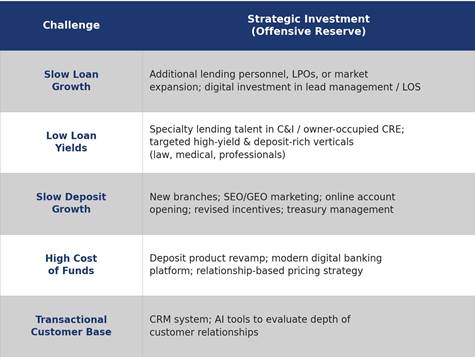
Once you’ve set your defensive buffer, you need to determine how to deploy capital to meet and exceed shareholder expectations. Capital above the defensive buffer is dry powder to be deployed offensively into balance sheet growth. Digital, physical, and talent investments don’t just grow assets — they compound shareholder returns. Different challenges require different types of investments, all of which require the use of the offensive reserve.
HUB | Taylor Advisors’ Take:
All these challenges require deploying capital to create a more profitable and enduring institution amid rapid change. HUB | Taylor Advisors provides advice that goes beyond the question of whether you should elect CBLR now that it’s 8%. If you haven’t evaluated your capital deployment strategy, that’s where we start. Contact us to learn how HUB | Taylor Advisors helps community banks put their capital to work.
An Associate Member of many State Banking Associations, HUB | Taylor Advisors provides consulting and advisory services in the areas of ALCO, capital, liquidity, interest rate risk, and investments to community-based financial institutions throughout the country. To learn more, visit www.tayloradvisor.com or contact Todd Taylor at todd.taylor@hubinternational.com and Mark Miller at mark.miller@hubinternational.com
You have already subscribed to distributions. Thank you for your interest in our publications!